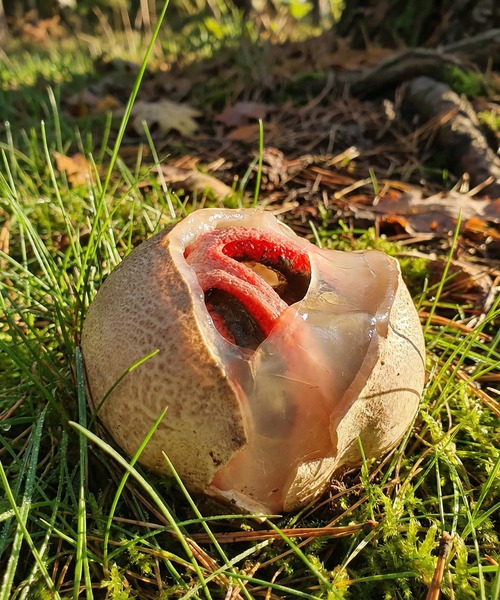
On an ordinary morning, I stepped into my garden expecting nothing more dramatic than watering flowers and shooing away the neighborhood cats. But the moment I opened the gate, an unexpected, pungent odor drifted through the air—sharp, heavy, and instantly unsettling. When I followed the smell toward the flowerbed, I spotted something shifting slightly on the ground. It was oddly shaped, reddish, and glistening as if it had been turned inside out. For a split second, my mind flooded with wild ideas—some mysterious animal, a diseased plant, or something unfamiliar and possibly dangerous. I stood frozen in place, debating whether to ignore it, investigate, or abandon my yard entirely until someone braver came along.
Eventually, curiosity pushed me past hesitation. I approached slowly, careful not to touch or disturb whatever it was. Up close, the object remained unrecognizable, which only intensified the discomfort of not knowing what I was dealing with. Trying to calm my racing thoughts, I took a photo with my phone and began searching for answers. The internet delivered dozens of theories—some scientific, some ridiculous—but one explanation appeared repeatedly: a bizarre-looking fungus that tends to alarm unsuspecting gardeners. The suggestion was reassuring enough to shift my fear into cautious fascination. Maybe there wasn’t a threat lurking in my yard—maybe it was simply nature showing me one of its stranger, lesser-known faces.
The more I read, the clearer the picture became. The fungus was described as unusual but harmless, something that blooms after damp weather and releases a strong odor to attract insects. Its sudden appearance and striking appearance are exactly what make so many people mistake it for something alarming. With that knowledge, the uneasy mystery melted away. When I returned outside, I looked at the strange growth differently—not as something intrusive or frightening, but as a sign of how complex and unpredictable gardens can be. The environment hadn’t changed overnight; I had merely encountered something outside my comfort zone.
As I finished watering the flowers, I realized how symbolic the experience was. The fear I felt came not from danger, but from uncertainty—proof of how quickly the mind fills empty spaces with worst-case scenarios. That morning reminded me that even unsettling moments can become opportunities to learn when we slow down and seek understanding. I walked back inside feeling lighter, grateful that a moment of surprise had turned into a quiet lesson: not everything unfamiliar deserves panic. Sometimes, all it needs is curiosity, patience, and a closer look.