• The rich man cut off his son after learning that his fiancé from a rural village was…

    The rich man cut off his son after learning that his fiancé from a rural village was…

    A Surprising Arrival

    Robert Whitman expected a rundown shack. Instead, a vibrant homestead stretched before him. Lush green fields, blooming gardens, and neatly painted fences surrounded a charming, well-kept house. The property radiated warmth, prosperity, and care.

    Stepping out of his luxury car, disbelief washed over him. Children’s laughter echoed from the garden. Three lively toddlers played joyfully, giggling with a contagious energy. They were Jason’s children, unmistakably carrying their parents’ features—blond hair and warm smiles.

    A Strong, Radiant Presence

    Emily, the “country girl” Robert had dismissed, emerged from the house. She shone with quiet confidence, her presence commanding respect. She greeted him warmly, her composure hinting at someone who had faced challenges and thrived.

    Jason followed, holding one child’s hand. He looked different—mature, content, and genuinely happy. Responsibility and love marked his face, the signs of a man embracing life fully.

    “Father,” Jason said, extending a firm handshake. No bitterness lingered, only a sincere welcome. Robert, momentarily speechless, felt pride swell within him as he accepted it.

    “Jason… this place,” Robert said, gesturing around, “it’s incredible.”

    Jason chuckled. “It’s not just me. Emily has been amazing. Together, we’ve made this place something special.”

    Building a Life Together

    Emily arrived with refreshments. “We’ve worked hard,” she said, meeting Robert’s gaze with kindness. “When Jason came here, we decided to make the most of it. We turned the land into an organic farm and launched a small bed and breakfast. People love escaping the city.”

    Robert’s skepticism melted. He had expected struggle, failure, and regret. Instead, he found innovation, success, and genuine happiness. The harsh words he once directed at his son now felt absurd. Guilt pricked at him for past judgments.

    An Apology and Reconciliation

    “Emily, Jason,” Robert began, clearing his throat, “I owe you both an apology. I was wrong. Seeing this… I can’t express how proud I am.”

    Jason and Emily exchanged a knowing glance. “We’re glad you’re here, Dad,” Jason said sincerely. “We’d love for you to be part of our lives—and the kids’ lives, too.”

    A visit meant to mock turned into reconciliation. Robert spent the day with his family, watching his grandchildren play and learning about the life Jason and Emily had built.

    True Wealth

    Robert realized that true wealth isn’t money or status. It’s love, resilience, and creating beauty despite adversity.

    The man who once disinherited his son left enriched—not with possessions, but with the legacy of love and strength Jason had forged in a rural village.

  • Supreme Court Steps In and Delivers Massive 8-1 Ruling

    Supreme Court Steps In and Delivers Massive 8-1 Ruling

    Supreme Court Gives Donald Trump Admin Win

    President Donald Trump achieved a significant triumph at the U.S. Supreme Court, garnering support from normally liberal justices.

    The court annulled a lower court injunction that was obstructing the president from revoking the protected legal status of hundreds of thousands of migrants presently living in the United States.

    The ruling was 8–1 in support of the president’s position, with the sole dissent originating from Justice Ketanji Brown Jackson, appointed by former President Joe Biden.

    The ruling facilitates the Trump administration’s efforts to revoke Biden-era Temporary Protected Status (TPS) for approximately 300,000 Venezuelan migrants residing in the U.S.. It permits the administration to proceed with the immediate deportation of these migrants, as asserted by the administration’s legal representatives.

    During his address to the Supreme Court last month, U.S. Solicitor General John Sauer asserted that the lower court had exceeded its jurisdiction.

    He stated that “the district court’s reasoning is untenable,” asserting that the program “involves particularly discretionary, sensitive, and foreign-policy-laden judgments of the Executive Branch concerning immigration policy.”

    Secretary of the Department of Homeland Security Kristi Noem rescinded Temporary Protected Status in a February memo, with an effective date in April.

    On October 3, 2023, Venezuela was again recognized for Temporary Protected Status (TPS) owing to exceptional and temporary circumstances that hinder the safe repatriation of Venezuelan nationals.

    Following an assessment of the prevailing situation in the country and consultations with relevant U.S. government agencies, the Secretary of Homeland Security has concluded that Venezuela no longer satisfies the criteria for the 2023 designation.

    It has been concluded that allowing the designated Venezuelan nationals to remain temporarily in the United States is against the national interest.

    The memo stated, “Consequently, the 2023 TPS designation for Venezuela is being revoked.”

    “On March 9, 2021, Secretary of Homeland Security Alejandro Mayorkas designated Venezuela for Temporary Protected Status (TPS) due to his assessment of ‘extraordinary and temporary conditions’ in Venezuela that hindered the safe return of its nationals, asserting that allowing these individuals to remain temporarily in the United States aligns with U.S. national interests,” it stated.

    The memo stated, “On September 8, 2022, former Secretary Mayorkas prolonged the Venezuela 2021 TPS designation for 18 months.”

    On October 3, 2023, Secretary Mayorkas prolonged the Venezuela 2021 TPS designation for an additional 18 months, expiring on September 10, 2025.

    He also designated Venezuela for 18 months, referring to this decision as a ‘redesignation’ (Venezuela 2023 designation), which expires on April 2, 2025, thereby establishing two distinct and concurrent Venezuelan TPS designations. Refer to the Extension and Redesignation of Venezuela for Temporary Protected Status.

    On January 17, 2025, Secretary Mayorkas announced an extension of Venezuela’s TPS status from 2023 for an additional 18 months.

    The notification was predicated on Secretary Mayorkas’s assessment on January 10, 2025, that the criteria for the designation remained satisfied. Refer to INA 244(b)(3)(A), (C), and 8 U.S.C. 1254a(b)(3)(A), (C).

    In the January 2025 announcement, Secretary Mayorkas neither explicitly extended nor terminated the 2021 designation for Venezuela.

    The announcement made it easier for all eligible Venezuelan TPS recipients to apply for TPS by the new deadline of October 2, 2026, regardless of whether they were under the 2021 or 2023 designations, as stated in the DHS memo.

    On January 28, 2025, Secretary of Homeland Security Kristi Noem annulled former Secretary Mayorkas’s decision from January 10, 2025, reinstating the prior status quo.

    U.S. District Judge Edward Chen of the Northern District of California suspended Noem’s initiative in March, finding that the depiction of migrants as potential criminals was “unfounded and replete with racism.”

    As of late October 2025, the Department of Homeland Security (DHS) says that more than 527,000 people have been deported (removed) since Trump took office on January 20, 2025.

    DHS says there were 1.6 million voluntary leaves out of a total of about 2 million departures.

    The agency believes these numbers will continue to increase on a monthly and yearly average with more funding and resources.

  • Sally Field, 76, reflects on aging gracefully while navigating Hollywood’s expectations

    Sally Field, 76, reflects on aging gracefully while navigating Hollywood’s expectations

    Sally Field, celebrated for her work in Steel MagnoliasForrest Gump, and many other classics, has long stood out in Hollywood for embracing natural aging. Now 76, she has spent her career resisting industry pressures that often encourage women to alter their appearance, choosing instead to appreciate the strength and wisdom that come with time.

    Her journey began on television with shows like Gidget and The Flying Nun before she transitioned into a successful film career. Over the years, Field has delivered memorable performances in beloved films such as Norma RaeMrs. Doubtfire, and Smokey and the Bandit. Her talent has earned her two Academy Awards, three Primetime Emmys, and several other honors that highlight her remarkable impact on the industry.

    In February 2023, Field received the Screen Actors Guild Lifetime Achievement Award, where she delivered a warm and humble speech reflecting on her decades of work. Appearing radiant in a black gown and embracing her naturally gray hair, she spoke about her deep love for acting and the joy it continues to bring her.

    Field has openly shared her perspective on aging, acknowledging the pressures many face in Hollywood while encouraging self-acceptance. She believes in honoring one’s authentic self and views aging as a privilege rather than something to resist. Her confidence and grace continue to inspire fans, making her a powerful example of beauty, resilience, and staying true to oneself.

  • ‘Mystery Man’ Who Donated $130 Million to Pay US Troops ID’ed: You Won’t Believe Who It Is

    ‘Mystery Man’ Who Donated $130 Million to Pay US Troops ID’ed: You Won’t Believe Who It Is

    WHOA: ‘Mystery Man’ Who Donated $130 Million to Pay US Troops During ‘Schumer Shutdown’ IDed

    We’re now 25 days into what’s being called the Schumer Shutdown — Democrats are still holding the government hostage over a laundry list of left-wing demands. They apparently thought Republicans would just roll over and fund every one of their pet projects without question.

    On Thursday, Democrats once again showed just how little they care about ordinary Americans by tanking a bill that would have temporarily provided pay to essential federal workers. Classy move.

    But by Friday, there was a silver lining. President Trump announced that an anonymous donor had stepped up with a $130 million contribution to help pay the troops during the shutdown. Then, on Saturday, The New York Times revealed the identity of that Good Samaritan — Timothy Mellon, the reclusive billionaire heir to the Mellon banking fortune.

    It is important to note that while this story is receiving widespread media coverage, neither Mellon nor Trump has confirmed its accuracy as of this writing. However, the Wyoming resident has made significant donations in the past. For instance, the day after Trump was convicted of 34 counts of falsification of business records in 2024, as part of New York Attorney General Letitia James’ efforts against him, he donated an impressive $50 million to a Trump PAC.

    Despite his immense wealth (estimated by Forbes at $14.1 billion) and recent history of donating large sums, Mellon remains somewhat of a Mystery Man:

    Mr. Mellon, the heir to the Pittsburgh-based Mellon banking family, also has been the biggest donor to independent candidate Robert F Kennedy’s campaign.

    The BBC has contacted Mr. Mellon for comment about his political donations.

    Known as a recluse, the Wyoming-based Mr. Mellon avoids the spotlight and social circles of other US billionaires.

    Mellon isn’t your typical billionaire — he’s a bit of an old-school adventurer. A passionate aviator, he once funded an expedition to uncover what really happened to Amelia Earhart, the legendary pilot who vanished over the Pacific in 1937. In 1998, he even purchased the name, logo, and branding of the defunct Pan Am airline to use for his railroad ventures. (Pan Am Railways was later acquired by CSX Corporation in 2022.)

    While Mellon’s $150 million donation is undeniably generous, it raises questions about how — or whether — those funds can legally be used while Schumer continues to hold the government hostage with his shutdown tantrum:

    The Pentagon accepted his grandson’s donation, but might not be able to use the funds: the Ant deficiency Act bars agencies from spending money that has not been appropriated by Congress during a shutdown.

    “The donation was made on the condition that it be used to offset the cost of service members’ salaries and benefits,” said Pentagon spokesman Sean Parnell.

    Let’s hope the administration finds a way to put that money to use and get our troops paid — because if there’s anyone who shouldn’t be caught in the crossfire of Washington’s political games, it’s the men and women who wear the uniform.

  • Deadly Prison Riot Leaves 31 Inmates Dead as Authorities Probe Cause

    Deadly Prison Riot Leaves 31 Inmates Dead as Authorities Probe Cause

    A night of intense violence inside a prison in southwest Ecuador left at least 31 inmates dead on Sunday, according to the country’s national prisons agency, SNAI. The deadly unrest erupted before dawn in the coastal city of Machala, shocking nearby residents who reported hearing gunfire, explosions, and cries for help coming from behind the prison walls.

    Authorities Confirm Deaths but Details Remain Unclear

    In a statement posted on X (formerly Twitter), SNAI said 27 prisoners died from asphyxiation and “immediate death by hanging.” The agency did not release further information about the circumstances, and officials emphasized that the exact sequence of events remains under investigation. Forensic teams were dispatched to the site to verify the causes of death and identify the victims.

    Earlier in the day, authorities had confirmed four other deaths linked to the same outbreak of violence. Tactical police units were deployed shortly after riots began around 3:00 a.m., ultimately regaining control of the facility.

    Injuries Reported and Motive Under Investigation

    In addition to the fatalities, at least 33 inmates and one police officer were injured, SNAI reported. The agency did not indicate whether the incident was tied to ongoing disputes between rival criminal groups, though gang-related violence has become a frequent trigger for prison uprisings in Ecuador.

    Officials noted that the riot appeared to have been sparked by a reorganization of prisoners following the opening of a new maximum-security facility. Such transfers often heighten tensions among incarcerated members of competing gangs.

    Ecuador’s Prisons: Epicenters of Criminal Conflict

    Ecuador’s penitentiary system has been at the center of regional security concerns. Prisons have become operational hubs for drug-trafficking gangs, whose violent power struggles have left more than 500 inmates dead in recent years.

    A 2024 report by Insight Crime described the prison system as the “epicenter” of organized crime in the country, with criminal networks coordinating operations both inside and outside the facilities.

    President Daniel Noboa’s administration has pledged to confront the crisis, repeatedly attributing the violence to powerful gangs fighting for territorial control and influence over lucrative trafficking routes.

    A Pattern of Deadly Riots

    Sunday’s tragedy is the latest in a series of brutal prison clashes that have shaken Ecuador:

    • September 2025: A riot in the same Machala prison left 14 inmates dead and another 14 wounded, with prisoners reportedly using guns and explosives.
    • Days later: Another 17 inmates died during a riot in the northern city of Esmeraldas. Authorities found decapitated bodies and shared shocking images of the aftermath.
    • Since 2021: Ecuador has seen multiple prison massacres, including the country’s deadliest in Guayaquil, where more than 100 inmates were killed.

    These outbreaks have left families desperate for information, often waiting for hours outside prison gates, hoping for news about their loved ones.

    A Nation on the Front Lines of Global Drug Trafficking

    Ecuador’s geographic position between Peru and Colombia, the world’s largest cocaine producers, has turned the small nation into a major transit point for the global drug trade. Government statistics indicate that more than 70% of the world’s cocaine shipments now pass through Ecuadorian ports.

    This surge in drug-related activity has fueled violence nationwide, transforming Ecuador—once considered one of the region’s safer countries—into one of Latin America’s most dangerous.

    A Crisis Rooted in the Prison System

    Experts warn that the ongoing wave of violence cannot be addressed without significant reform inside Ecuador’s prisons. Insight Crime notes that the foundations of the crisis are deeply tied to the criminal structures that have evolved within the penitentiary system, where gangs wield enormous influence.

    As investigations continue into the deadly Machala riot, Ecuador faces mounting pressure to restore control over its prisons and curb a crisis that has already claimed hundreds of lives.

  • From Childhood to History: The Story Behind This Influential Figure

    From Childhood to History: The Story Behind This Influential Figure

    The life of a woman who later became widely known in U.S. history began with a childhood marked by instability. Born in Michigan in 1956, she experienced early challenges after her father entered the correctional system and passed away during his sentence. She and her sibling were raised by their grandparents, though the home environment was often difficult and unpredictable.

    Accounts from later years describe a household that lacked consistency, contributing to long-term emotional struggles. In her early teens, she faced several hardships that shaped the direction of her life. She became pregnant at a young age and ultimately chose adoption for her child, hoping to provide opportunities she felt she could not offer at the time.

    After leaving school, she attempted to earn a living through various forms of work while trying to establish independence. During the 1970s, she encountered several legal issues involving minor offenses, reflecting the challenges she faced in maintaining stability. Additional personal losses and emotional difficulties further influenced her circumstances. She eventually moved to Florida, seeking a fresh start, but her personal struggles continued.

    Over the following years, she became involved in a series of legal cases that brought her significant national attention. Aileen Wuornos, whose life has been widely discussed in documentaries, books, and films, became the focus of public examination regarding how early adversity, lack of support, and long-term emotional distress can contribute to complex behavioral patterns later in life. Her story is frequently referenced in discussions about the impact of early-life trauma and the importance of accessible mental-health resources.

  • Hollywood Just Lost One Of Its Kindest Souls—The Untold Story Of Markie Post’s Final Years

    Hollywood Just Lost One Of Its Kindest Souls—The Untold Story Of Markie Post’s Final Years

    There are certain faces from television history that feel like home—warm, familiar, timeless. Markie Post was one of those faces. For anyone who grew up watching Night Court, The Fall Guy, or even later shows like Chicago P.D., Markie wasn’t just a performer on a screen. She was that spark of kindness, that polished confidence, that mix of humor and sincerity that made you feel like everything in the world could still turn out alright.

    When she passed away in 2021, the news felt like a sudden silence. Even people who hadn’t followed her life closely for years remembered what she meant to them. Her characters were comforting. Her humor was effortless. Her presence glowed. And behind all the fame and the laughter, her real life was marked by strength, grit, and a kind of humility rare in Hollywood’s constant glare.

    When Melissa Joan Hart Shared Her Heartbreak With the World

    The first message that captured just how deeply Markie was loved came from Melissa Joan Hart. They had worked together on Holiday in Handcuffs, playing mother and daughter. But when Melissa wrote her tribute, there was nothing “work-related” about her grief. It was personal.

    “I’m heartbroken to lose an angel here on earth,” she wrote, the words almost trembling off the page. “My dear friend and TV mother Markie Post is finally at rest after a long hard battle with cancer. I can’t describe what she meant to me—the friendship we had, the kindness she showed me. Love you so much, Markie. You will be forever missed.”

    Her message hit millions of fans like a cold wind. Many had no idea Markie had been fighting cancer at all. She’d kept it quiet, choosing dignity over publicity, focusing on work, family, and the parts of life that mattered most.

    Remembering a Woman Who Made Hollywood Feel a Little Kinder

    People who followed Markie throughout her career often describe the same impressions: kindness, strength, humor, confidence. She had this soft glow about her—a natural warmth that made her characters memorable without ever trying too hard.

    Fans wrote messages like:

    “She always seemed so strong and confident. I never knew she was fighting cancer.”

    “She was such a great actress. I’m so sad to hear she’s gone.”

    “Rest in peace, Markie… and thank you for everything you gave us.”

    You could tell these weren’t just obligatory condolences. They came from people who felt like they’d lost a part of their childhood, their comfort TV, their memories.

    How an American Girl From California Found Her Way Into the Living Rooms of Millions

    Markie Post didn’t grow up with dreams of fame. Born in 1950 in Palo Alto and raised in Walnut Creek, California, she came from what most would call an intellectual household. Her father was a nuclear physicist, her mother a poet. Creativity and intelligence were part of the everyday air she breathed.

    Her real name was Marjorie, but as her siblings struggled to pronounce it, “Markie” naturally stuck—and became the name millions would one day recognize.

    In high school, Markie was a cheerleader. She later studied physics in college, more out of respect for her father than her own passion. But physics didn’t quite love her back.

    “I was intimidated by my father,” she once admitted. “He was the dearest man, but he’d say, ‘It’s so easy!’ while helping me with equations. That didn’t make it easy for me.”

    Her honesty about her early academic struggles was refreshing, especially coming from a woman who would one day shine so brightly in a different world.

    Before the Spotlight: Markie’s Humble First Job in Show Business

    Markie’s early career in entertainment wasn’t glamorous. Long before she became a familiar face on television screens, she worked behind the scenes on game shows—researching questions, organizing materials, absorbing the mechanics of production.

    Her job on Split Second and Double Dare gave her what she called “the best education I ever had.”

    “I learned more researching that game show than I did in four years of college,” she joked during an interview in the 1980s.

    But those early days gave her more than skills—they gave her a foot in the door.

    The Break That Changed Everything

    Her first real break came with guest roles on series like Hart to Hart and Cheers. She wasn’t a household name yet, but producers quickly noticed something special—an effortless charm with just enough spark to make viewers instantly like her.

    In 1977, she made the full switch to acting. Then came The Fall Guy, where she portrayed Terri Michaels. This was the show that truly launched her. She became popular, admired, and recognizable.

    But even then, Markie wanted more than what fame alone offered.

    “I’m very functionary on that show,” she once said. “I’m like the tape at the beginning of Mission: Impossible. Sometimes they bring me into the caper and that helps.”

    She wanted to stretch, to dig deeper, to play someone with layers. And not long after, she got her chance.

    The Role That Made Markie Post an Icon

    In 1985, after a standout guest appearance, NBC producers asked her to join Night Court as Christine Sullivan—the sharp, kindhearted public defender with the perfect balance of strength and humor.

    Fans fell in love with her almost instantly.

    By the show’s third season, she was one of the brightest stars on TV. Her knack for timing, her endearing sincerity, and her undeniable beauty made her unforgettable.

    “People are crazy about our show,” she told the Courier-Post in 1986, almost shyly.

    She wasn’t just talented—she was disciplined. She worked harder than most people ever realized, eventually earning around $400,000 a year at her peak on the show.

    Yet she never bragged. She never presented herself as larger than life.

    In her own words:

    “I was like Wile E. Coyote—running off a cliff and not looking down. As long as I didn’t look down, I could just keep going.”

    The Beauty She Never Saw in Herself

    Markie’s beauty was part of her fame, but she never let it define her. She often insisted:

    “I’m no siren. I see prettier girls than me in the grocery store.”

    Fans would laugh at that modesty—because on-screen, Markie was captivating. Her eyes sparkled. Her smile lit up scenes. She had the kind of presence that needed no soundtrack, no dramatic lighting. She simply was.

    She once said she carried both her parents’ personalities:

    “My passionate, emotional side is from my mother. My logic and precision are from my father.”

    That combination—warmth and sharpness—became her trademark.

    Her Personal Life: A Hollywood Love Story That Actually Lasted

    Long before Hollywood became known for short marriages and quick splits, Markie and Michael A. Ross showed that love could last.

    They met in the early 1980s in an acting class. They married soon after and built a life in Toluca Lake, near Bob Hope’s residence. Their home became a haven of creativity, laughter, and stability in an industry where stability rarely lasted.

    Together, they raised two daughters—Kate and Daisy. They were a tight-knit family, the kind that supported each other’s careers and celebrated life’s small victories.

    In 2011, when asked about their long marriage, Markie said something beautifully real:

    “We just decided that no matter what, dead or alive, we’re getting to the end of our lives together. Life won’t always be wonderful. You’ll get bored, annoyed, tired. But if it’s wonderful 80 percent of the time, you’re lucky.”

    And they stayed lucky for 39 years—right up until the very end.

    The Battle She Fought in Silence

    Markie was diagnosed with cancer years before her passing. But she didn’t want pity or headlines. She chose privacy, resilience, and above all—normalcy.

    Her family later revealed that she saw her treatment as her “side job.” Even while undergoing chemotherapy, she continued working. She appeared in The Kids Are Alright, showing up with the same professionalism and grace she’d always carried.

    According to Deadline, she remained active in her career until she simply couldn’t anymore.

    Her family shared a tribute that captured her perfectly:

    “Our pride is in who she was as a person—someone who baked elaborate cakes for friends, sewed curtains for first apartments, and showed us how to be kind in a harsh world.”

    She passed away on August 7, 2021—just shy of her 71st birthday.

    The Voices That Rose After She Was Gone

    After her passing, tributes poured in from all corners of Hollywood—and from everyday viewers whose lives she’d unknowingly touched.

    Melissa Joan Hart’s grief was public and raw.

    Fans wrote messages filled with memories from decades past.

    And thousands simply said:

    “Thank you, Markie.”

    A Legacy That Still Feels Alive

    Markie Post was more than an actress. She was proof that grace can survive fame. That kindness can thrive in an industry known for competition. That beauty doesn’t need arrogance. That humor can be gentle. And that real strength—true strength—is quiet, patient, and softer than people expect.

    Her legacy lives on in every rerun, every fan memory, every tribute posted online, and every woman in Hollywood who watched her and thought:

    “I want to be like her.”

    She leaves behind a husband who adored her, daughters she inspired, friends who cherished her, and fans who will never forget what she brought into their homes.

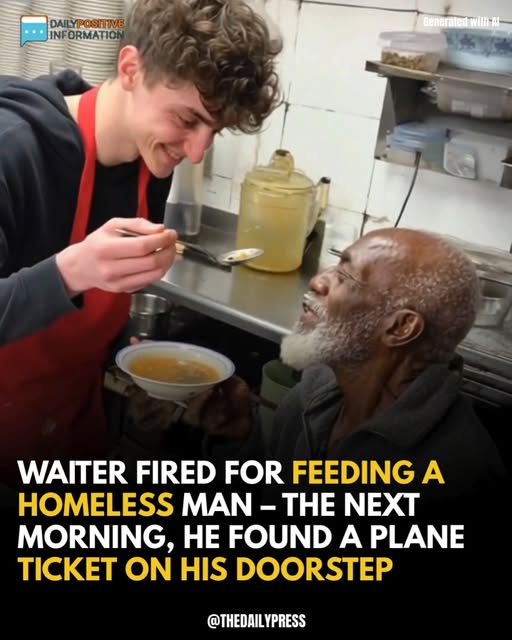
  • Waiter Fired For Letting Homeless Man Eat Indoors — Next Morning, A Plane Ticket Shows Up At His Door

    Waiter Fired For Letting Homeless Man Eat Indoors — Next Morning, A Plane Ticket Shows Up At His Door

    Have you ever had one of those days where the world seems hell-bent on breaking you? Where gravity feels a little heavier, and every breath is a reminder of how much air you don’t have?

    I was eighteen, but I felt like I’d aged a decade in the last two years. Life has a way of kicking you when you’re down, and then stomping on your ribs just for good measure.

    I worked at Callahan’s, a tiny, family-owned Italian place on the edge of a rusting industrial town in Ohio. It wasn’t the kind of place you saw on food blogs. It was the kind of place with red checkered tablecloths that were actually vinyl, plastic grapes hanging from the ceiling gathering dust, and a perpetual smell of garlic, floor wax, and damp coats.

    And before you get any ideas about a glamorous coming-of-age story, I wasn’t even a waiter.

    Management thought I looked “too green” for customer service. Too skinny, too quiet, too much like a kid who was afraid of his own shadow—which, to be fair, I was. So I was stuck in the back, the invisible cog in a greasy machine. I spent my shifts scraping gum off chairs, bussing tables until my back screamed, and scrubbing plates until my fingers pruned and bled around the cuticles from the industrial soap.

    I didn’t get tips. Just minimum wage and the constant, nagging hope I wouldn’t get yelled at for “standing around” while I was catching my breath.

    But I didn’t complain. Not once.

    After my parents died in a car accident—a slick patch of ice on a Tuesday night that turned my life upside down—I inherited their old house and the mess they left behind. It turns out that grief doesn’t stop the mortgage company from sending letters. The debt was crushing, a physical weight that sat on my chest every time I tried to sleep. The house was a mausoleum of memories, filled with half-finished projects my dad would never complete and books my mom would never read.

    I was barely staying afloat, one paycheck away from losing everything. So every dollar mattered. Every hour on the clock was a lifeline.

    Source: Unsplash

    The Night That Changed Everything

    Until that fateful night that cut straight to the bone.

    It was November. The kind of November that bites. The wind howled behind the restaurant like it had teeth, rattling the heavy metal door of the loading dock. I was taking out the trash, the bags in my arms already soaked through with rain and kitchen slop. I pulled my hoodie tighter, muttering curses under my breath as the cold seeped into my bones.

    The alley behind the building always smelled like sour grease and wet cardboard, a perfume of despair. But that night, something was different.

    Something moved near the dumpster.

    I stopped cold, my grip tightening on the slick black plastic.

    There, half-buried under a pile of damp blankets and cardboard boxes, was a man. He looked barely conscious, knees pulled to his chest, shaking violently. His clothes were rags, thin layers that offered no protection against the freezing rain. His lips were tinged blue, eyes fluttering open like it physically hurt to do so.

    “Sir?” I stepped closer, cautious but concerned. “Are you okay?”

    He tried to speak, but only a croak came out.

    “No… just cold… so cold…”

    I stood there for a second, torn between the paralyzing fear of what would happen if someone saw me—if Mr. Callahan saw me—and the overwhelming, human instinct not to let this man freeze to death five feet from a kitchen full of heat and leftover soup.

    Screw it.

    “Come on,” I said, pulling him up carefully. He was lighter than I expected, frail under the layers of grime. He smelled of rain and sickness. “This way. Quietly.”

    He could barely walk. I took him through the back door, moving fast, my heart thudding against my ribs like a trapped bird. I could already hear my boss’s voice in my head—“You don’t bring street rats in here, Derek! We run a respectable business!”

    I guided him to the supply closet near the break room. It was cramped, packed with boxes of paper towels and extra napkins, smelling of bleach and dust. But it was warm. And it was hidden.

    I grabbed a clean towel from the stack, wrapped it around his shivering shoulders, then ran to the kitchen. I moved like a ghost, dodging the line cooks who were busy shouting orders. I filled a bowl with leftover minestrone soup—thick, hot, and hearty—and grabbed a few rolls of bread from the warmer.

    When I handed it to him, his hands trembled so badly he almost dropped the spoon.

    “T-Thank you,” he whispered, the steam from the bowl hitting his face. And then, as he took a sip, he started crying—silent, shaking sobs between spoonfuls that broke my heart.

    “My name’s Arthur,” he managed to say between bites. “I used to play piano. Can you believe that? My fingers used to fly.”

    I looked at his gnarled, freezing hands. “I believe you, Arthur. You can stay here tonight,” I told him, my voice low. “Just until morning. The morning shift doesn’t come in until 9.”

    He nodded, eyes shining with a gratitude that made me feel small.

    But I wasn’t even two steps out of the closet when I heard it.

    The Confrontation

    “What the hell is going on back here?”

    I turned, and there he was. Mr. Callahan.

    He was a man built like a barrel, with wide shoulders and a face that was always red, like a volcano seconds from eruption. He stood at the end of the hallway, hands on his hips. His eyes zeroed in on the open supply closet door, then snapped back to me.

    “Is that—” he stormed past me, yanked open the door.

    Arthur cowered, pulling the towel tighter, the soup sloshing onto his lap.

    “You brought a homeless man into my restaurant?!” Callahan roared. “Are you insane?!”

    “Please,” I said, stepping between them, holding my hands up. “He was going to freeze. It’s thirty degrees out there. I was just trying to—”

    “I don’t care!” he shouted, spit flying. “This is a business, not a shelter! Do you know the health code violations? Do you know the liability? If a customer saw this, we’d be ruined!”

    The shouting echoed through the hallway. The staff stopped what they were doing. Even the clatter of dishes from the kitchen fell silent.

    “Fire him,” Callahan barked, jabbing a thick finger at me. “Right now. Get him out.”

    My heart dropped into my stomach.

    “Wait—Mr. Callahan, come on,” said Mark, the floor manager. Mark was a good guy, quiet, always tried to be fair. He stepped forward from the kitchen doorway. “He didn’t mean any harm. He was just trying to help. It’s freezing out there. The kid has a good heart.”

    “I don’t pay him for his heart! I pay him to clean plates!” Callahan barked again, not even looking at Mark. “And get that bum out of here before I call the cops!”

    Mark looked at me. His face was pale. His lips parted like he wanted to say something else, to fight for me… but he had a mortgage too. He had kids in college.

    “I’m sorry, Derek,” he whispered, his voice heavy with defeat. “You’re done.”

    And just like that, I lost my job. It was the only thing holding my world together, the only thing keeping the wolves from the door, and it snapped.

    Source: Unsplash

    The Long Walk Home

    I walked home in the rain that night.

    I didn’t even bother with the bus—what was the point of spending the $2.50? I needed the walk. I needed to feel the cold sting on my face to remind myself I was still here. Still breathing, even if barely.

    When I got home, my soaked shoes left muddy prints on the cracked tile floor of the entryway. The silence in that old house was louder than any shouting I’d faced earlier. It was a heavy, suffocating silence. I peeled off my wet hoodie and slumped into the kitchen, where a stack of unopened mail waited on the table like a threat.

    One envelope sat right on top, marked URGENT in red ink.

    I already knew what it was before I opened it. Another payment due. A final notice of foreclosure intent. One I couldn’t make. Not now, not ever, if something didn’t change.

    I sat down at the kitchen table, head in my hands, and just… let it crash over me. All of it. The debt, the job, my parents’ ghost still clinging to every room in that house. I felt like I was drowning on dry land. I looked around the kitchen where my mother used to bake blueberry muffins, where my father used to drink his coffee and read the paper.

    “I failed you,” I whispered to the empty room. “I lost the house.”

    I didn’t sleep much that night. I stared at the ceiling, counting the cracks in the plaster, wondering how long it takes to freeze to death if the heating gets cut off.

    The Envelope on the Porch

    But when I finally pulled myself off the couch the next morning, eyes gritty and swollen, and opened the front door to check the mailbox… I stopped.

    There was something on my doormat.

    A thick, sealed manila envelope. No name. No return address. Just sitting there, dry, as if the storm hadn’t touched it.

    I looked around. The street was empty. The morning fog was still clinging to the pavement. Frowning, I picked it up. It was heavy.

    I tore it open right there on the porch.

    Inside was a plane ticket.

    One way. To New York City.

    There was also a roll of crisp bills—hundreds, maybe thousands—wrapped in a rubber band. And a folded piece of paper.

    My hands shook as I opened the note. The handwriting was neat, precise.

    “Derek,

    What you did yesterday showed the kind of man you are. You didn’t lose your job — you outgrew it. Integrity is expensive, and you paid the price without blinking. I have a friend who manages one of the most prestigious restaurants in Manhattan. I told him about you. He agreed to hire you as a trainee. This cash is for a start. Go. You have a future much bigger than this town.

    Mark.”

    Mark?

    Mark—as in the same manager who fired me? The guy who stood there and let Callahan kick me out? He must have come by in the middle of the night. He must have dipped into his own savings for this.

    I sat on the porch step, stunned. The wind picked up the edge of the envelope, fluttering the plane ticket, but I didn’t move. My eyes burned, and I let them.

    For the first time in years, I cried.

    Not because I was broken… But because someone, finally, believed I was worth saving. Someone saw me.

    And just like that, the door I thought had slammed shut the night before had led to something else entirely. A fire escape.

    A beginning.

    Source: Unsplash

    The City of Lights and Shadows

    I flew to New York the next day. The plane touched down just after dawn, the city skyline rising out of the mist like a jagged crown.

    I’d never been on a plane before. I’d never even left my home state. But there I was—18 years old, one backpack filled with everything I owned, a wad of cash I was too scared to count in public, and a job I didn’t dare believe was real.

    I took the subway into Manhattan. The noise was a physical assault—the screech of metal wheels, the hum of voices in a dozen languages, the buskers playing drums on plastic buckets. It smelled of ozone and hot pretzels and urine. It was terrifying. It was electric.

    The address Mark gave me led to a building in Tribeca. The Gilded Lily.

    It was… massive.

    I stood outside the heavy oak doors for ten minutes, smoothing down my shirt, trying to wipe the travel dust off my shoes. I looked at my reflection in the window. I looked like a kid. A lost kid.

    I pushed the doors open.

    Inside, crystal chandeliers hung from the ceiling like frozen fireworks. Floors so polished I saw my reflection in them. Waiters in tailored uniforms glided across the room like ballet dancers, balancing silver trays with an elegance that seemed impossible. It felt more like a palace than a place to eat.

    And me?

    I stood there in borrowed dress shoes that pinched my toes, heart thudding like a drum against my ribs.

    “Can I help you?” a hostess asked, looking me up and down with a skepticism that made me want to shrink.

    “I’m here to see Julian,” I said, my voice cracking. “Mark sent me.”

    Her expression changed instantly. “Oh. Wait here.”

    Moments later, a sharp-dressed man with silver hair and the posture of a general walked toward me. He moved with a fluidity that commanded attention without demanding it.

    “Derek, right?”

    “Yes, sir.”

    He looked me up and down, not with judgment, but with assessment. He checked my fingernails. He checked my shoes. He checked my eyes.

    “I’m Julian. Mark told me you were green but worth the gamble. He said you have integrity. In this city, talent is cheap, but integrity is rare.”

    “I… I’ll work hard,” I managed to say. “I won’t let you down.”

    He raised an eyebrow. “Good. Because this place doesn’t slow down. We serve senators, celebrities, and people who can ruin your career with a single tweet. You give me one reason to regret this, and you’re out. Understand?”

    “Yes, sir.”

    “Start in the back. You have to earn the floor.”

    The First Winter

    The first six months were a blur of exhaustion and homesickness.

    New York in winter is not like the movies. It’s grey slush at the crosswalks and wind that tunnels through the avenues like it’s hunting you. My apartment in Queens was a fourth-floor walk-up with a radiator that hissed and banged but produced no heat. I shared it with three other guys—a line cook, a taxi driver, and a jazz musician who practiced at 3 AM.

    Christmas Eve was the hardest.

    The restaurant was closed. My roommates had all gone home to their families or were working parties. I was alone in the apartment, wrapped in a blanket, eating a bodega sandwich.

    I scrolled through social media on my cracked phone. I saw pictures of people from my high school getting married, having babies, celebrating in warm living rooms. I felt an ache in my chest that was so sharp I almost couldn’t breathe.

    I thought about the house in Ohio. I had used Mark’s money to pay the back mortgage, but I had to rent it out to keep it. I was a landlord to my own childhood home, living like a pauper in a city of kings.

    I almost packed my bag right then. I almost went to the bus station.

    But then I looked at the little notepad I kept by my bed. It was filled with notes on wine pairings, French service terms, and napkin folds. I turned to the first page, where I had taped Mark’s note.

    You have a future much bigger than you think.

    I closed my eyes. I ate my sandwich. And I stayed.

    Source: Unsplash

    The Broken Glass

    The real test, however, wasn’t the loneliness. It was the fear of failure.

    Two months later, on a busy Friday night at The Gilded Lily, I made a mistake. A big one.

    I was running a tray of expensive red wine—a vintage Bordeaux that cost $400 a bottle. I was moving through the crowded dining room when a customer backed his chair out without looking.

    I swerved. My foot caught the edge of a rug.

    Smash.

    The sound silenced the room. Red wine exploded across the pristine white tablecloth of Table 6. Glass shattered everywhere. The customer, a wealthy investment banker, jumped up, shouting about his suit.

    I froze.

    Flashbacks of Mr. Callahan roared through my head. You idiot! Get out! You’re fired! I stood there, trembling, waiting for the screaming to start. I waited for Julian to storm over and throw me out on the street.

    Julian did walk over. He moved calmly through the chaos. He signaled two busboys to clean the mess. He spoke quietly to the customer, offering to pay for the cleaning and comping the meal.

    Then he turned to me.

    I braced myself. “I’m sorry,” I whispered. “I’ll pack my things.”

    Julian looked at me, confused. “Why?”

    “Because… I ruined it. I cost you money.”

    Julian sighed. He put a hand on my shoulder—not to shove me, but to steady me.

    “Derek, look at me.”

    I looked up. His eyes weren’t angry. They were serious, but calm.

    “We are not saving lives here,” Julian said. “We are serving dinner. It is just wine. It is just glass. Did you drop it on purpose?”

    “No, sir.”

    “Did you try to save it?”

    “Yes, sir.”

    “Then go to the back, clean yourself up, get a fresh apron, and get back on the floor. Mistakes happen. Panic is a choice. Do not choose panic.”

    I stared at him. This was leadership? This wasn’t fear?

    “Go,” he said gently.

    That night, I didn’t just learn how to carry a tray. I learned how to be a leader. I learned that fear creates mistakes, but confidence fixes them.

    The Search for Arthur

    Years passed. I moved up the ranks. I became the General Manager. I had money in the bank. I had a nice apartment.

    But there was a loose thread.

    One night, sitting in my office at The Gilded Lily, I hired a private investigator back in Ohio. It cost me a week’s salary, but I needed to know.

    I wanted to find Arthur.

    I wanted to tell him that the bowl of soup I gave him hadn’t been for nothing. That his suffering that night had launched my life.

    Three weeks later, the PI called me.

    “I found him,” the voice said. “Arthur Penhaligon.”

    “Is he… is he okay? Can I send him money?”

    There was a pause.

    “He passed away, Derek. Two years ago. Pneumonia.”

    My heart sank.

    “But,” the PI continued, “I found out something else. He wasn’t just a homeless guy. He was a music teacher for thirty years. He lost his mind a bit after his wife died, stopped paying bills, ended up on the street. But the shelter records say that a few years ago, someone gave him a heavy winter coat and a wad of cash. He used it to get into a halfway house for a few months. He spent his last year teaching kids at the center how to play piano.”

    I gripped the phone. The cash. Mark.

    Mark had gone back. Mark had finished what I started.

    I hung up the phone and cried. Not out of sadness, but out of a fierce, burning resolve. Arthur didn’t die in that alley. He died teaching music. Because we tried.

    The Shark and the Dream

    When I finally decided to open my own place, the investors circled like sharks. I had the reputation now. I was the “Boy Wonder” of the New York restaurant scene.

    One meeting stands out.

    I was sitting in a glass-walled conference room with a venture capitalist named Sterling. He was offering me two million dollars. It was enough to build my dream restaurant three times over.

    “I love the concept,” Sterling said, leaning back in his leather chair. “upscale comfort food. Very trendy. But I have some notes on the business plan.”

    “Okay,” I said.

    “This ‘Community Hour’ you have listed. Where you open the back door from 4 to 5 PM for the homeless? No. Absolutely not.”

    “It’s non-negotiable,” I said.

    Sterling laughed. “Derek, be serious. You can’t have bums lining up next to a place where people pay fifty dollars for a steak. It ruins the brand. It kills the property value.”

    “The brand,” I said, standing up, “is hospitality. True hospitality. Not just for the people who can afford it.”

    “You’re being naive. You take my money, you play by my rules. No free soup. No back door charity.”

    I thought about the debt I used to have. I thought about the fear of poverty. Two million dollars could fix everything forever.

    But then I thought about Arthur shivering in the closet. I thought about Mark handing me that envelope.

    “Then I don’t want your money,” I said.

    Sterling looked shocked. “You’re walking away from two million dollars?”

    “I’m walking away from a bad partner,” I said. “Keep your money. I’ll find another way.”

    I walked out. I didn’t have the funding yet, but I had my soul.

    The Reunion

    I hadn’t heard from Mark in a long time. Life moved fast in the city, a blur of seasons and shifts. I sent him Christmas cards, updates, checks to pay him back (which he never cashed), but he was a man of few words. I figured he had his own path to walk.

    But on a rainy Tuesday afternoon, like something out of a movie, I saw a familiar silhouette at the front desk.

    It was raining hard, a relentless downpour that turned New York gray.

    A man stood there, shaking off a wet umbrella. Gray blazer. Shoulders a little more slumped than I remembered. Kind eyes that looked tired, etched with the lines of hard years.

    He looked at the opulent dining room, clearly hesitating, wondering if he was in the wrong place.

    “Reservation for Mark,” he said to the hostess, his voice quiet.

    I froze. I was standing near the bar, reviewing the night’s wine list. I looked up.

    It was him.

    The years stripped away. I wasn’t the General Manager in a tailored Italian suit. I was the kid in the hoodie, soaking wet, holding a plane ticket.

    I smiled. A real, genuine smile that felt like sunshine breaking through the clouds. I handed the wine list to the sommelier and walked over. I straightened my jacket, took a deep breath, and stepped into his line of sight.

    “Right this way, sir.”

    Mark turned, confused at first. He saw a man in a tailored suit, confident, commanding the room. He saw the expensive watch, the polished shoes.

    Then his eyes landed on my name tag.

    Derek M. General Manager

    He didn’t say anything. He just stared at me for a second, then blinked like he couldn’t trust his own eyes. His mouth opened slightly, then closed.

    “…You did it,” he whispered. The pride in his voice cracked a little.

    I shook his hand—firmly, this time. Then I pulled him into a hug right there in the lobby, ignoring the decorum of the high-end establishment. “No,” I said, my voice thick with emotion. “We did. You believed in me when no one else would. You saved me, Mark.”

    He nodded, swallowing hard, patting my back. The same man who once had to fire me to save his own skin… was now my honored guest.

    Source: Unsplash

    The Dinner of a Lifetime

    I didn’t let him pay for a thing. I escorted him to Table 1, the best seat in the house by the window overlooking the rain-slicked cobblestones.

    “Derek, this is too much,” Mark said, looking at the white linen. “I just wanted to see how you were doing. I didn’t expect… this.”

    “It’s not enough,” I said.

    I sat with him. I let my assistant run the floor.

    We talked for hours.

    I learned that Callahan’s had closed down two years ago. Tax evasion. Callahan had lost everything. Mark had been working at a diner, scraping by, but he was happy. He had grandkids now.

    I told him about Arthur. I told him about the PI report.

    Mark went quiet. He swirled his wine.

    “I wondered,” Mark said softly. “I wondered if he made it.”

    “He did,” I said. “Because of you.”

    I sent out a custom tasting menu: truffle risotto (the real deal), wagyu beef that melted on the tongue, a chocolate soufflé that required perfect timing. I paired every course with wines I selected myself.

    Mark ate with a look of wonder. “I remember you eating stale bread in the breakroom,” he laughed.

    “I remember you sneaking me sandwiches,” I countered.

    He sat there, looking around at the restaurant—my restaurant—with the quiet pride of a teacher watching his student take flight. He watched me direct the staff with a nod, handle a complaint with a whisper, welcome guests with a smile.

    The Next Dream

    As he was leaving, the rain had stopped. The city lights reflected on the wet pavement, turning the street into a river of gold.

    Mark put on his coat. He looked older than when he arrived, but lighter.

    “You were never just a busboy, Derek,” he said, smiling. “You were just waiting for the right place to shine. I knew it the moment I saw you help that man.”

    I laughed softly. “And you were the one who opened the door. You gave me the key.”

    Mark chuckled, buttoning his coat. “You ever think about owning your own place someday? You run this place like it’s yours, but… it’s not.”

    I raised an eyebrow, grinning. I reached into my jacket pocket and pulled out a folded piece of paper. It wasn’t just a blueprint; it was a promise.

    “Funny you ask,” I said. “Got a meeting next week with a potential investor. A good one this time. One who understands the mission.”

    Mark looked at the blueprint. It was a smaller space. Intimate. Warm. And in the corner of the layout, there was a designated space.

    “What’s this?” Mark pointed.

    “That,” I said, “is an upright piano. For live music.”

    Mark looked at me, understanding dawning in his eyes.

    “And see the back door?” I pointed. “It stays unlocked from 4 to 5. Soup kitchen style.”

    “It looks… welcoming,” Mark said, his voice thick.

    “It will be,” I said. “Think New York’s ready for a place called The Open Door?”

    Mark’s face lit up. His eyes crinkled at the corners. And with a laugh that warmed the damp air, he said, “Yes, it is. And I’ll be the first customer.”

    I watched him walk down the street until he disappeared into the city night. I stood there for a long time, breathing in the air of the city that had adopted me.

    I had lost my job for doing the right thing. But I had gained a life.

    And as I walked back inside The Gilded Lily, ready to close up for the night, I knew one thing for sure: When I opened my own place, the back door would always be unlocked for anyone who was cold.

    Because you never know when an angel might be sleeping by the dumpster.

    Let us know what you think about this story on the Facebook video! If this story touched your heart, please share it with friends and family to spread the message that kindness always comes back around.


  • Celebrity‘80s Actress Vanished From Hollywood After A Nose Job — AI Reveals How She Might Look Today Without It

    Celebrity‘80s Actress Vanished From Hollywood After A Nose Job — AI Reveals How She Might Look Today Without It

    She was formerly America’s sweetheart, a youthful, emotive actress who illuminated every screen she graced. However, following a solitary decision under the spotlight of notoriety, her previously ascending career was abruptly halted. She would never receive the same recognition again.

    This esteemed performer of the 1980s, lauded for her charisma and classic cinematic performances, discreetly withdrew from public view after undergoing a plastic surgery treatment that rendered her practically unrecognizable. Decades later, artificial intelligence provides an insight into her appearance had she not modified her face.

    A Broadway Bloodline and the Weight of Expectation

    The actress is the progeny of a Tony-nominated luminary, renowned for his performance in “Cabaret,” both on Broadway and in the film adaptation. He also performed in “George M!,” “Goodtime Charley,” “The Grand Tour,” a revival of “Chicago,” and portrayed the original Wizard of Oz in “Wicked.”

    Indeed, her father is the illustrious Joel Grey, at 93 years old, who frequently features in her Instagram posts. Their friendship is evidently genuine, marked by sentimental reminiscences and significant milestones, including her presentation of the Lifetime Achievement Tony Award to him.

    In a touching Father’s Day post from 2018, she even wrote“I am fortunate to have a dad who has always made me feel loved, who loved to play, and taught me so much about art, and food, flowers, and travel, and showing up. thank you dad, i love you [sic].”

    Her Meteoric Rise to Fame

    She then emerged as a prominent figure, cherished for her performances in 1980s classics such as “Red Dawn” and “Ferris Bueller’s Day Off.” However, none were more emblematic than her portrayal of Frances “Baby” Houseman in “Dirty Dancing.”

    The actress is Jennifer Grey.

    Despite reaching the pinnacle of her stardom after her film with Patrick Swayze, Jennifer swiftly vanished from the Hollywood landscape, leaving many unaware of the reasons behind her departure. The pivotal decision made in 1989, which would torment her for decades, was to have rhinoplasty.

    The Surgery That Changed Everything

    “I went into the ­operating room a ­celebrity and came out anonymous,” the actress told the Mirror in 2012. “It was the nose job from hell. I’ll always be this once-famous actress nobody ­recognises because of a nose job.”

    In her 2022 memoir, “Out of the Corner,” Jennifer ultimately disclosed the complete truth of her surgery and its consequences. In the prologue, she highlighted that despite the worldwide acclaim of “Dirty Dancing,” the anticipated offers did not materialize. Many assumed it was due to her appearance.

    In accordance with the precedent set by various family members, she proceeded with the procedure. However, complications necessitated a second surgery, and upon its conclusion, her appearance had altered significantly. Suddenly, the world perceived her differently.

    Source: Wikipedia

    The Fallout on Set and in the Press

    The timing was exceptionally poor. At that time, she was prepared to film supplementary scenes for the movie “Wind” under the direction of Carroll Ballard. She needed to contact him to elucidate the events that transpired.

    She issued an apology, and the production team endeavored to accommodate her by photographing her via mirrors or from a distance. The endeavor was unsuccessful. Ballard subsequently informed the media that the project failed due to her surgery.

    In the preface of her memoir, Jennifer elaborated on the profound shame that ensued. Individuals murmured in her absence, alleging that she had perpetually despised her appearance and desired further cosmetic procedures. Attempts to console her simply exacerbated the situation.

    Jennifer felt that she’d become nothing but a nose. “There’s no rest of me worth knowing. Overnight, I lose my identity and my career,” she wrote.

    Public Rejection and Private Pain

    The actress ultimately recognized that the occurrence was a concealed benefit, however at that moment, it seemed like a harsh obliteration. On certain days, strangers were incredulous that she had ever been referred to as “Baby.”

    In an interview with People, she elucidated the rationale for incorporating the narrative in the memoir’s prologue. She was fatigued by being misinterpreted and evaluated as an individual who had repudiated her natural nose. She particularly resented that ladies with “imperfect” noses identified with her suffering.

    The reality was markedly dissimilar.

    “That I would disfigure myself or be, you know, unable to be satisfied — it’s not my story,” she revealed. “I actually never wanted the nose job in the first place.”

    The Real Reason Behind the Decision

    The actress had always liked her looks. But Hollywood didn’t. “And it made me feel like, dude, there’s nothing wrong with how I am, except I couldn’t get a job. I’d become famous, and then I couldn’t get a job,” she added.

    In a separate interview to promote her memoir, Jennifer informed ABC that she earned only $50,000 from “Dirty Dancing,” and no other offers were forthcoming. Subsequently, an individual indicated her nose.

    And everything started to align.

    Her family had evacuated Ukraine to evade persecution as Jews. In America, they altered everything they could to assimilate, including their surnames. Her father, mother, grandmother, and aunt had all undergone rhinoplasty.

    For aspiring individuals in the entertainment industry, rhinoplasty was not merely an option; it was an imperative. Jennifer attempted to withstand. However, she ultimately acquiesced. She undertook the action for the sake of survival. It was unsuccessful. When individuals ceased to recognize her, she found herself in a “surreal” condition of being renowned yet invisible.

    What would her appearance be now had she not undergone the surgery?

    Reimagining Jennifer Grey

    In astonishing new images, AI illustrates what Jennifer could resemble now had her contentious rhinoplasty not occurred. Initially, the authentic photograph is presented. Subsequently, the revised edition. Warning: it is astonishing!

    The disparity is rather significant. Few comprehend the profound impact a single rhinoplasty may have on an individual’s identity. Let us proceed to another reinterpreted point, where the distinction is rather more nuanced.

    While the alteration is little, it suffices to restore the visage that characterized a generation. Now, let us advance to the subsequent period, in which she appears much more youthful.

    Jennifer appears to have emerged directly from the 1980s in this context. The enthusiasm, vitality, and inspiration are all present. Let us examine one final reinterpretation that undoubtedly revives “Baby.”

    The capabilities of AI are extraordinary, and although the actress may never reverse past events, and the world may never perceive her as it once did, these images poignantly illustrate that even minor choices may yield significant consequences.

  • She Told 911 There Was Someone In Her Room—What Police Found Still Haunts The Neighborhood

    She Told 911 There Was Someone In Her Room—What Police Found Still Haunts The Neighborhood

    It was the kind of night no one remembers. Quiet street. Houses lined up like dominoes. Curtains drawn, families asleep, the world pretending it was safe.

    Then the phone rang at dispatch.

    The operator almost brushed it off. Calls like this came in often—kids scared of the dark, bad dreams, the usual. But the moment she picked up, she froze.

    On the other end was a girl. Five years old. Her voice wasn’t playful, or sleepy. It cracked, like it hurt to even speak.

    “Please… come quick. There’s someone in my room.”

    That was it. Barely a sentence. But the kind that makes your stomach drop.

    The Arrival

    A patrol car slid into the neighborhood. Everything looked normal—porch lights glowing, sprinklers ticking away, not a hint of chaos.

    The officer had seen it all before: frightened children, parents rolling their eyes, houses that creaked too loud. He knew better than to laugh it off, but he didn’t expect much either.

    The girl’s mother opened the door, tired and confused. “She gets these nightmares,” she said, waving it off.

    But the child wasn’t dreaming. She was sitting up in bed, her stuffed elephant locked in her arms, eyes wide like she hadn’t blinked in an hour. She didn’t look at the door or the window. She raised her finger… and pointed at the vent.

    Something in the Walls

    The officer leaned in. Just a rusty old grate, nothing unusual. Still, he crouched, shining his light inside.

    That’s when the pieces started to fall apart.

    The duct led to a forgotten shaft, part of an old dumbwaiter system built decades earlier. Families had long since forgotten it existed. But someone hadn’t.

    Inside, officers later found scraps: food wrappers. A flashlight. What looked like bedding. And footprints pressed into the dust.

    The girl hadn’t been imagining anything. Someone had been there. Living inside the walls. Watching. Listening.

    Panic on the Block

    By morning, word had spread. Neighbors stood outside in their robes, whispering, trying not to believe what they were hearing. If one house had a shaft, then so did the others. If he’d been in her walls, he could have been in theirs too.

    The illusion of safety—gone in a single night.

    Parents double-checked locks that had never mattered before. Every creak in the floorboards suddenly felt like a warning. And that little girl’s face—those wide, unblinking eyes—haunted the entire street.

    No Ending, No Closure

    The search dragged on. Officers followed the trail as far as it would go. But whoever had been crawling through those shafts had already slipped away. The bedding was old. The wrappers stale. The prints fading.

    There would be no arrest. No mugshot to pin the fear on. Just the knowledge that for who-knows-how-long, someone had been hiding in the shadows of their homes.

    And the only reason anyone knew at all… was because a five-year-old had the courage to speak up.

    What Stays With You

    Here’s what chills people most: not the fact that someone was there, but how close it came to being ignored.

    The dispatcher could have shrugged it off. The officer could have stayed in the car. The mother could have told her daughter to stop making things up. And then what?

    That child’s tiny, fragile voice pulled back the curtain on something no adult wanted to believe. And in doing so, she may have saved herself—and others.

    The Aftermath

    That house was secured. Vents sealed. Locks reinforced. But the truth doesn’t patch over that easily.

    Even years later, people on that street said they never heard silence the same way again. Every draft of air felt suspicious. Every faint noise behind a wall carried the question no one wanted to ask out loud: Is someone there?

    The Lesson

    Monsters don’t always kick down doors. Sometimes, they slide quietly through the cracks we never check.

    That night, the bravest person wasn’t the cop, or the mother, or the dispatcher. It was the little girl with the stuffed elephant, voice shaking, who refused to keep it inside.

    She didn’t scream. She didn’t cry. She spoke just loud enough to be heard. And that was enough to change everything.