
Brain teasers are a great way to exercise your mind and improve problem-solving skills, and one of the most popular puzzles online is the classic “six eggs riddle.” At first, it seems like a basic math question, but the challenge actually lies in understanding the wording rather than doing calculations. These types of riddles are designed to test attention to detail and logical thinking, making them both entertaining and mentally stimulating for people of all ages.
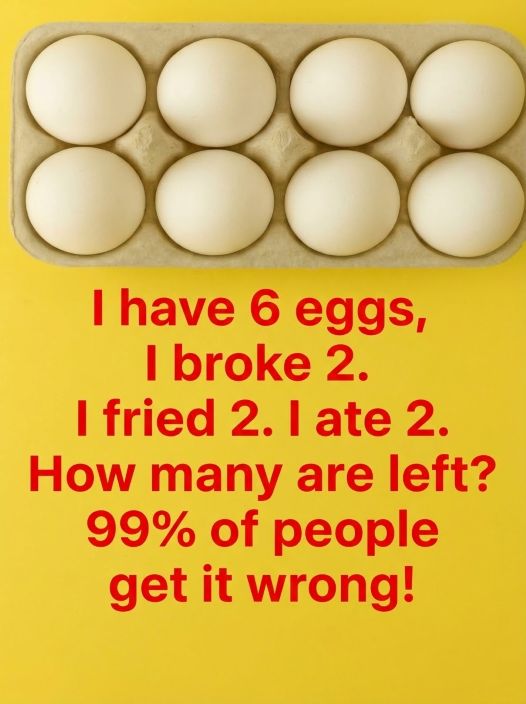
The riddle is usually presented like this: “I have six eggs. I broke two, fried two, and ate two. How many eggs are left?” Many readers quickly answer “zero” because they assume each action uses a different set of eggs. It feels natural to add the numbers together and conclude that all six eggs are gone. This quick response is exactly what the riddle expects — a reminder of how easily our brains can jump to conclusions without fully processing the information.
The key to solving the puzzle is to slow down and think through each step carefully. To fry eggs, you must first break them. And to eat them, they must already be cooked. This means the same two eggs were broken, then fried, and finally eaten. No additional eggs were used in the process. Instead of six eggs being consumed, only two were actually prepared and eaten.
Once this detail becomes clear, the solution is simple. You started with six eggs, used only two, and the remaining four were never touched. Therefore, four eggs are still left. This small but clever riddle is a fun reminder that good problem-solving often depends more on careful reading and logical reasoning than on quick calculations.